Subtotal $0.00

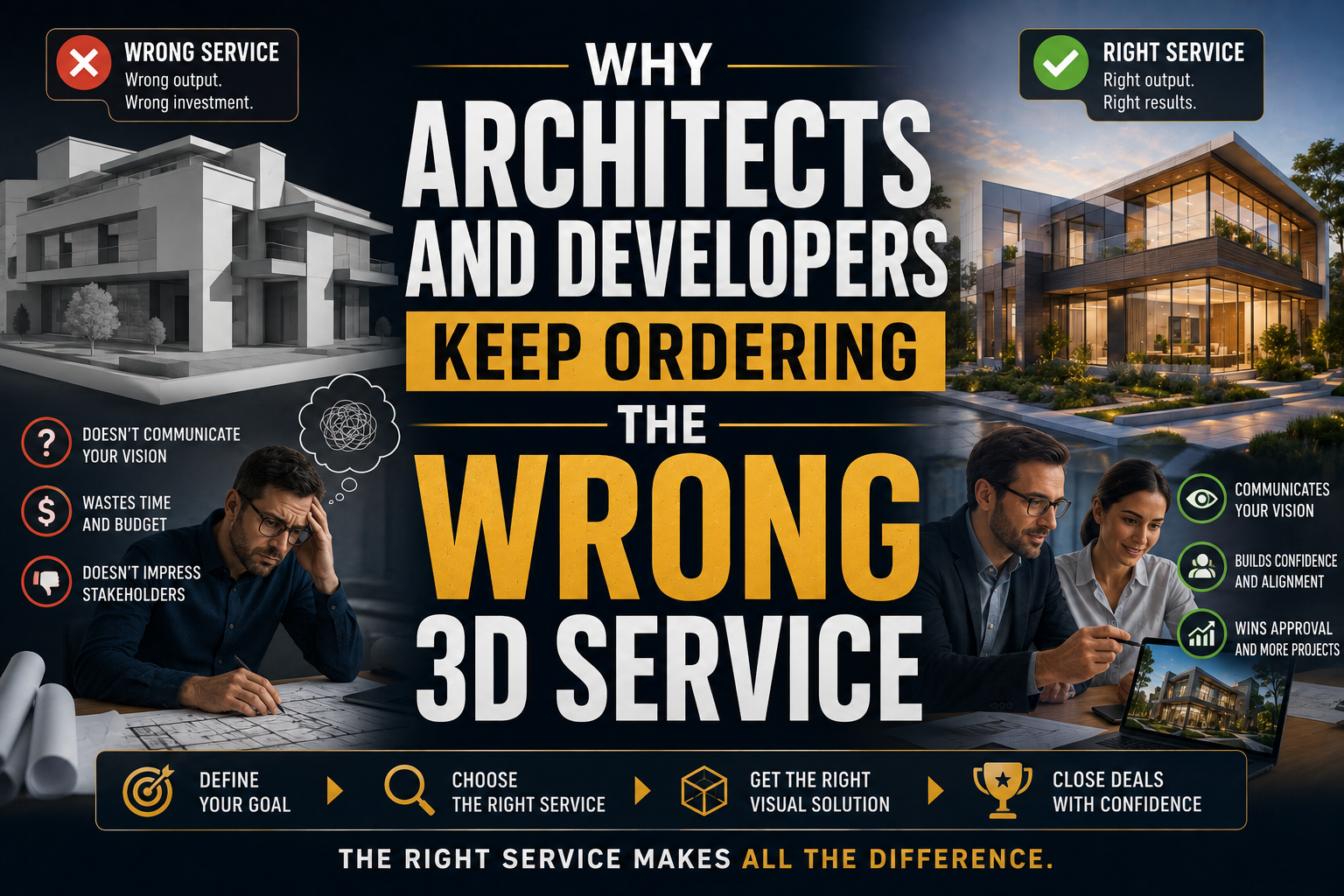
An architect specifies “3D rendering services” for a project that actually needs 3D visualization. Six weeks later, they have beautiful images but no actual 3D model for modifications, no ability to iterate on design changes, and no data about the space beyond what the pretty pictures show. They’ve spent money on presentation-ready output without any of the underlying digital assets that would actually help during design development.
This confusion between rendering and visualization is remarkably common, and it usually costs time and money to resolve mid-project.
Why the Confusion Exists
The terms are used interchangeably in casual conversation, which makes sense on the surface both produce visual outputs. But what they actually deliver is fundamentally different, and choosing wrong means getting something that doesn’t serve your actual needs.
Rendering is specifically the process of generating 2D images or videos from a 3D model. It’s the final output step lighting, textures, shadows, reflections all calculated and baked into an image or video. Rendering is about presentation.
Visualization is the broader process of creating digital 3D models and space data that can be used for exploration, iteration, and analysis. Rendering is one part of visualization, but visualization includes modeling, texturing, and all the data-rich work that precedes final image generation.
The confusion happens because:
Vendors use the terms loosely. A company offering “3D rendering services” might actually create full 3D models then render them, making it sound like they’re only providing images. A company offering “3D visualization services” might actually be offering 3D models, renderings, or both. The terminology isn’t standardized.
Clients assume they’re the same. A first-time buyer assumes “I want a 3D picture of this space, so I need 3D rendering.” They don’t realize the vendor could be delivering either just pretty images, or a full 3D model plus images, depending on what was actually ordered.
The outputs look similar to the untrained eye. A rendering looks like visualization output, so someone might think they’re interchangeable. They’re not.
What You Actually Get With Each
3D Rendering delivers: Finished 2D images or videos showing a design under specific lighting conditions from predetermined camera angles. Beautiful, presentation-ready, locked in. Can’t be easily modified or viewed from different angles without re-rendering. No underlying model data, just the visual output.
3D Visualization delivers: A complete 3D digital model of the space or product, typically with all the data embedded (materials, finishes, dimensions, structures). That model can be rendered into images from any angle, animated through the space, modified and iterated, or used for analysis and coordination. The model is the asset; renderings are just one output from it.
When This Matters (And When It Doesn’t)
Rendering is the right choice when:
- You need a finished image for marketing or presentation
- The design is locked and you don’t need to modify it
- You just need to see “what does this look like” from one or two specific viewpoints
- Budget is tight and you only need finished pictures, not model data
Visualization is the right choice when:
- You’re still in design development and need to iterate
- Multiple team members need to explore the space from different angles
- You need the underlying model data for coordination, estimation, or analysis
- You want to be able to easily modify and re-render without re-doing the whole project
- You might repurpose the model for other applications (VR, animation, further rendering)
The Cost of Choosing Wrong
Ordered rendering, needed visualization: You get beautiful images but no ability to modify them without expensive re-rendering. A client wants to see the space from a different angle? That’s a change order. Want to try a different material on that wall? That’s another render cycle, more time, more cost.
Ordered visualization, needed just rendering: You pay for a full 3D model and all the data infrastructure when you only need finished pictures. You’re overpaying for capabilities you don’t need.
The first scenario is far more common and far more expensive to correct. A full 3D model created during visualization that generates renderings is easy. Trying to extract model data from finished renders after the fact is nearly impossible.
How to Avoid This
Before requesting a quote or placing an order:
Define what you actually need. Are you in design development (need visualization, need the model) or final presentation (need rendering, need images)?
Ask specifically what you’re getting. Don’t assume “3D rendering” means just images or just a model. Ask: “Will I receive a 3D model I can modify? Or only finished rendered images?”
Understand the data you need. If your project might need coordination, changes, or analysis, you need the underlying 3D model. If you just need marketing images, rendering is sufficient.
Plan for future use. If you think you might repurpose the 3D model for other applications later (VR, animation, further refinement), get the model created during visualization. Trying to build a model from finished renders later is inefficient.
The Terminology Clarification That Matters
For professionals ordering these services, the real distinction is simple: Visualization creates 3D models and data. Rendering creates 2D images from those models. Rendering is one component of the visualization process. You can’t render without a 3D model, but you can have a 3D model without final renderings.
For anyone confused about which service actually solves their problem, understanding this distinction and understanding what each process actually delivers is the first step toward ordering right and getting what you actually need.
This detailed explanation of the differences between 3D rendering and visualization services breaks down exactly what each process includes, what each produces, and what use cases fit each approach, which is exactly the clarity needed before committing a budget to one or the other.
The Bottom Line
3D rendering and visualization sound like the same thing, but they’re fundamentally different deliverables that serve different purposes. Rendering is the final image output. Visualization is the entire process of creating 3D digital assets that can be rendered, modified, analyzed, and repurposed. Knowing which one you actually need before placing an order saves money, time, and the frustration of discovering mid-project that you ordered the wrong thing.