Subtotal $0.00

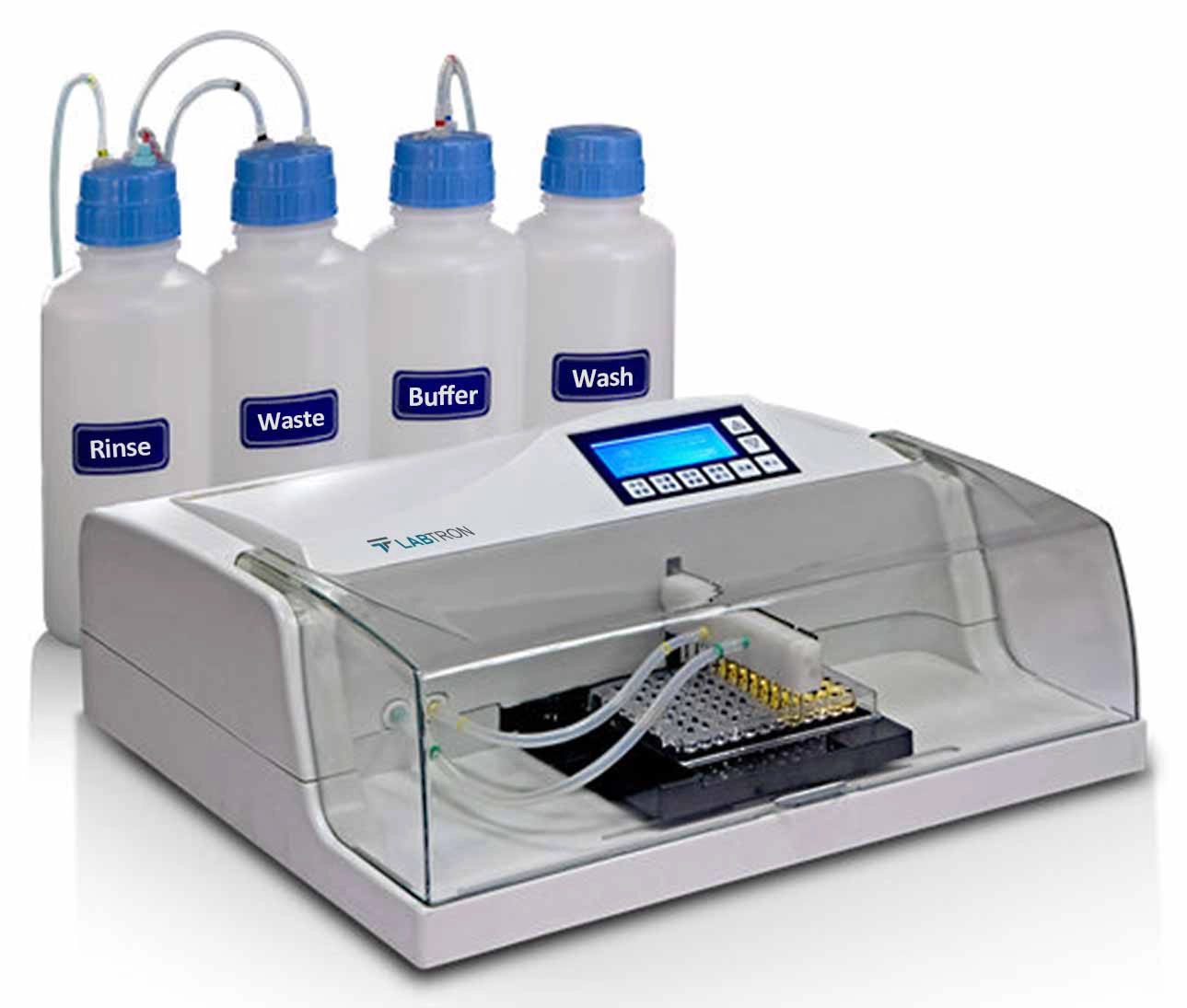
The washing step in an ELISA assay is where variability comes to life. A squeezed bottle with slightly different pressure between wells. A manifold held at a slightly different angle than last time. Aspiration that empties some wells completely and leaves microliters of residual buffer in others. None of this is visible in the moment. It becomes visible later, as elevated background, compressed standard curves, and coefficients of variation that are good enough to pass but not good enough to trust. The microplate washer exists to make every one of those variables go away.
Automated plate washing is not a luxury for high-throughput labs. It is a quality decision for any lab where ELISA results inform real decisions. This guide covers what an automated microplate washer does, what makes one model better than another, and how to select the right one for your specific workflow.
What Automated Washing Actually Controls
A microplate washer controls four washing parameters that manual methods leave variable: dispense volume per well (programmed precisely, not estimated from hand pressure), soak time between dispense and aspiration (programmed and held consistently, not timed by a person looking at their watch), aspiration speed (controlled to ensure complete removal without disturbing the bound layer), and aspiration height (the distance between the probe tip and the well bottom, which determines residual volume).
The industry benchmark for high-quality automated washing is less than 2 microliters of residual volume per well after aspiration. Manual washing typically leaves 5 to 15 microliters depending on technique. That residual volume is not just wash buffer. It contains whatever unbound material was not removed in that cycle, and it contributes to the background that inflates your blank readings and reduces assay sensitivity.
Protocol Memory: The Feature That Protects Multi-Operator Labs
If you have more than one person running assays on the same washer, protocol memory is not optional. It is the feature that ensures every operator runs every plate under exactly the same washing conditions, regardless of how familiar they are with the specific assay or how many plates they ran last week.
Without saved protocols, every operator enters parameters manually before each run. Manual entry introduces transcription errors, operator-to-operator differences in how they interpret protocol specifications, and the subtle drift of “good enough” parameter settings that degrades assay performance gradually rather than suddenly. A saved, validated protocol in a microplate washer with protocol memory eliminates all of these sources of variability simultaneously.
Strip Compatibility for Low-Volume Labs
Not every lab runs full 96-well plates for every assay. For labs that regularly process partial plates, a microplate washer that washes individual strips of 8 or 12 wells efficiently and accurately is significantly more practical than one that requires a full plate setup for every run. Strip compatibility also reduces reagent consumption for partial-plate runs and reduces the time per plate when fewer samples are being processed.
Verify that strip mode in any washer you are evaluating performs at the same quality as full-plate mode. Some instruments apply different aspiration or dispense parameters in strip mode that produce worse residual volumes or less consistent wash quality than full-plate operation.
Double Aspiration and Anti-Clogging Design
Two specific design features distinguish high-quality microplate washers from adequate ones: double aspiration and active anti-clogging systems. Double aspiration means the instrument performs a second aspiration pass after the first, repositioning slightly to capture residual liquid that the first pass missed. This consistently produces lower residual volumes than single-pass aspiration, with a measurable effect on assay background in sensitive immunoassays.
Active anti-clogging systems rinse and soak the dispense and aspiration needles automatically when the instrument has been idle for a defined period, preventing buffer crystallization inside the needle channels that would otherwise produce inconsistent dispense patterns or partial blockages that show up as unexplained well-to-well variability.
The Stat Fax 2600: A Purpose-Built Clinical and Research Washer
The Programmable Stat Fax 2600 Microplate/Microstrip Washer, available through trusted lab suppliers like NE LabSystems, addresses the practical requirements described above directly. It washes flat, round, and V-bottom plates and strips, performs automatic calibration and last row detection, supports programmable wash protocols with mix, soak, and timing functions, and applies double aspiration for complete liquid removal. It is NRTL- and CE-certified for clinical use.
Trusted lab suppliers like NE LabSystems back the Stat Fax 2600 and the full washer range with free extended warranties on U.S. purchases and factory-trained engineering support. Browse the washer range online or call (877) 733-6838 to discuss which model fits your assay types, plate formats, and throughput needs. Your wash step is where assay quality is made or lost. It is worth getting right.