Subtotal $0.00

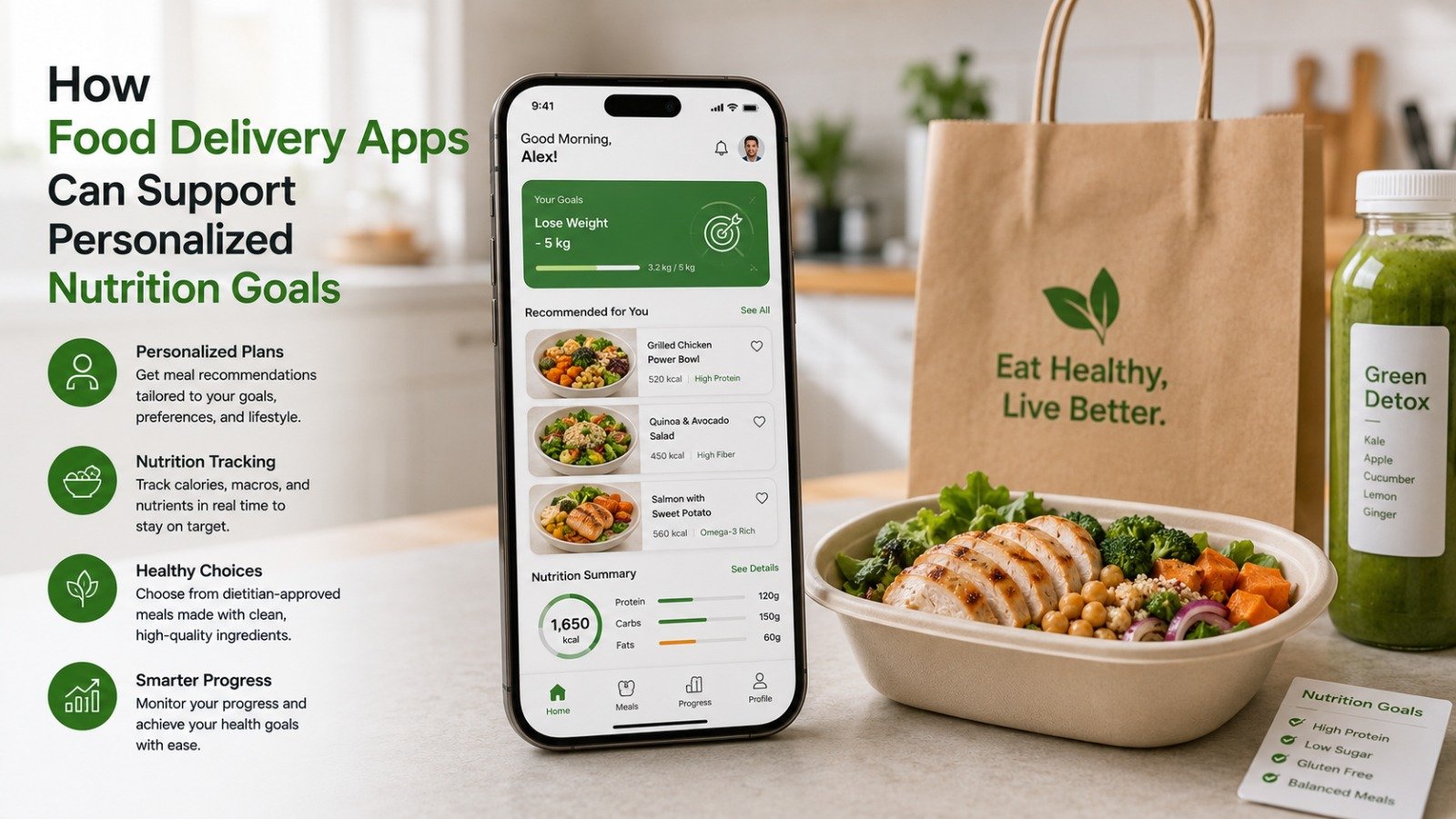
How Food Delivery Apps Can Support Personalized Nutrition Goals
Leila Nasseri had been managing Type 2 diabetes for three years before she found a routine that worked, and the routine was exhausting. Every meal required her to look up glycemic index values, calculate portion sizes, estimate carbohydrate loads, and cross-reference the result against her target daily macros and her dietitian’s latest guidance. Eating out was a research project. Ordering delivery was worse, because restaurant nutritional information was frequently unavailable, inconsistently formatted when it was available, and bore only a loose relationship to what actually arrived in the container. She was not unusual among people managing chronic conditions through dietary intervention. The effort required to maintain precise nutritional awareness while using food delivery platforms, whose default ordering experience is optimized for impulse and appetite rather than for health goals, was significant enough that most people simply gave up on the precision and hoped for the best. When a food delivery application she had been using launched a personalized nutrition mode that integrated with her continuous glucose monitor through her phone’s HealthKit connection, flagged meals likely to produce glycemic spikes based on her personal glucose response history, and allowed her to filter an entire restaurant’s menu by carbohydrate load per serving in seconds, the experience of managing her condition through food delivery changed materially. She started ordering more frequently, with more confidence, and with measurably better glucose control in the 30-day period after she adopted the feature. The Food Delivery App Development company that built that feature had not changed the restaurant’s menu. They had changed what Leila could know about it and what she could do with what she knew. That distinction, between changing the food and changing the information environment around the food, is where the most significant nutritional personalization opportunity in food delivery applications currently lives.
Why Food Delivery Platforms Are Positioned to Support Nutrition
Food delivery applications occupy a uniquely powerful position in the nutritional decision-making chain because they sit at the exact moment when a user is making a food choice rather than before or after it. A nutrition education application, a meal planning tool, or a dietitian consultation all operate at a remove from the moment of decision. A food delivery application is the moment of decision.
That positioning gives food delivery platforms the ability to influence nutritional outcomes through the interface design choices they make without requiring users to seek out nutritional information proactively. A restaurant menu that displays calorie counts alongside prices, that highlights high-protein options with a visual marker, that sorts results by alignment with the user’s stated dietary preferences rather than by restaurant advertising spend, and that surfaces nutritional warnings on items that conflict with a user’s flagged medical conditions is not asking the user to do research. It is doing the research for them and presenting the result in the context where it is immediately actionable.
The business case for nutritional personalization in food delivery is also more aligned than it might initially appear with the commercial incentives of the platform. A user who trusts the platform to support their health goals uses it more frequently, with higher average order values, because they are ordering from it for the full range of meals they eat rather than only for occasions when nutritional precision doesn’t matter. Leila ordered 40% more frequently in the month after adopting the personalized nutrition feature than she had in the prior month, because she now felt comfortable ordering meals that fit her health goals rather than defaulting to home cooking for any meal where control mattered.
Dietary Profile Systems and the Foundation of Personalization
The nutritional personalization chain begins with understanding what each user actually needs from a nutritional perspective, and that understanding requires a dietary profile system that goes significantly beyond the allergy flags and dietary preference labels that most food delivery platforms currently offer.
A meaningful dietary profile for nutritional personalization captures several distinct types of information. Medical dietary requirements that are clinically significant, including conditions like diabetes, celiac disease, chronic kidney disease, and phenylketonuria that require precise nutritional management, need to be handled with a seriousness that preference labels don’t convey. Nutritional targets that reflect the user’s specific health goals and, ideally, the guidance they have received from a healthcare provider or registered dietitian provide the framework against which menu options can be evaluated. Food intolerances and preferences that affect the user’s experience without rising to the level of medical requirement fill out the picture with the practical information that determines what the user actually wants to eat.
Collecting that information through a well-designed onboarding flow, and updating it as the user’s health status and goals evolve, creates the data foundation that all downstream personalization depends on. Without a reliable dietary profile, nutritional personalization is guesswork. With one, the application can evaluate every item on every restaurant’s menu against a specific, individual set of criteria rather than a generic healthy eating standard.
Nutritional Data Infrastructure and the Restaurant Integration Challenge
The most technically challenging aspect of nutritional personalization in food delivery applications is the nutritional data coverage problem. Personalization that depends on nutritional information can only function where that information exists and is accurate, and the nutritional data available for restaurant menu items is inconsistent, incomplete, and frequently outdated.
Large chain restaurant nutritional data is generally available through official nutritional databases and direct API partnerships that food delivery platforms have established with major chains. Independent restaurant nutritional data is sparse, often self-reported, and may not accurately reflect the portion sizes and ingredient quantities of the items as they are actually prepared and served. The gap between nutritional data coverage for a major fast-casual chain and a local independent restaurant is significant enough to affect the user experience of nutritional personalization in ways that the platform needs to be honest about rather than papering over with low-confidence estimates.
Several approaches are being deployed to address this coverage gap. AI-powered nutritional estimation from menu descriptions, using natural language processing to infer likely ingredient composition and estimated nutritional content from item names and descriptions, provides low-confidence estimates that are better than no information while being clearly labeled as estimates rather than verified data. Restaurant operator tooling that makes it easy for independent operators to enter and maintain their nutritional information, with the platform providing the input interface and the user-facing display as an incentive, grows coverage organically as operators who want to attract health-conscious customers see the value of participating.
Personalized Filtering and the Meal Discovery Experience
The user-facing expression of nutritional personalization in food delivery applications is the filtering and discovery experience that allows users to find meals matching their specific nutritional criteria from among the full range of available options. A user who needs to keep a meal under 40 grams of carbohydrate, above 30 grams of protein, and within a specific calorie range should be able to express those criteria once, in terms that match how they think about their dietary goals, and have the application translate them into a filtered view of every available restaurant’s menu that displays only the qualifying options.
The design of this filtering experience determines whether nutritional personalization feels like a powerful tool or a frustrating constraint. An application that filters the menu down to a small number of qualifying options and presents them clearly with the relevant nutritional context feels enabling. An application that presents the same filtering capability through a complex multi-parameter interface that takes several interactions to configure feels like it is asking the user to do work that the application should be doing for them.
Meal substitution suggestions that offer lower-carbohydrate, higher-protein, or lower-sodium alternatives to items a user has selected are a particularly effective UX pattern because they allow users to start from what they want rather than requiring them to start from what is nutritionally optimal. The application meets the user’s appetite first and then offers the pathway to the nutritionally better choice, which is a significantly more conversion-effective approach than leading with the constraint.
Wearable and CGM Integration
The integration of food delivery applications with continuous health monitoring devices represents the most technically sophisticated layer of nutritional personalization, and the layer that produces the most individually specific guidance. Leila’s experience with her continuous glucose monitor integration illustrates why: the nutritional data in any database represents an average response to an average person eating an average portion. Her personal glucose response data represents how she specifically responds to specific foods in specific contexts, which is the information that actually determines which foods are appropriate for her.
Platforms that integrate with Apple HealthKit and Google Health Connect can access the physiological data that users’ wearables are continuously generating and use that data to personalize nutritional guidance beyond what population-level nutritional information supports. A user whose post-meal glucose response data shows that they spike significantly on rice but not on pasta can receive restaurant suggestions that reflect that personal metabolic reality rather than the general diabetic guidance that would treat both similarly.
The privacy architecture of these integrations matters as much as the technical architecture. Health data that users share with a food delivery platform in exchange for personalized guidance needs to be used only for that purpose, stored with the protections appropriate to its sensitivity, and never used for advertising targeting or shared with third parties without explicit consent. Platforms that handle this trust well build the kind of user relationship that sustains long-term engagement. Those that mishandle it produce the kind of breach that is difficult to recover from.
The Investment and Build Considerations
For food delivery businesses evaluating whether to build nutritional personalization capabilities, understanding the factors affecting app development cost for features in this category is important for accurate planning. The cost drivers that are specific to nutritional personalization include nutritional database licensing and maintenance, the integration engineering required to connect with wearable health platforms, the restaurant partner tooling that enables nutritional data collection at scale, and the machine learning infrastructure that powers personalized recommendations based on individual dietary profiles and health data.
Those costs are real and significant, and they exist alongside the standard food delivery application infrastructure costs that any platform in the category must bear. The appropriate framing is not whether nutritional personalization is expensive to build but whether the retention and engagement benefits it produces, measured in the kind of concrete terms that Leila’s 40% ordering frequency increase represents, justify the investment. For platforms competing in a market where the standard ordering experience has become commoditized, the answer to that question is increasingly yes.
Leila’s glucose control improved measurably in the three months after she adopted the personalized nutrition feature. Her dietitian noted the improvement at their quarterly review and asked which intervention she attributed it to. Leila said she hadn’t changed her medication, hadn’t changed her activity level, and hadn’t changed her cooking. She had changed where she ordered from and which items she ordered, guided by an application that finally understood what she was actually trying to achieve when she ordered food rather than assuming she was optimizing for the same things as everyone else. That personalization, specific to her condition, her goals, and her metabolic reality, is what good food delivery nutritional personalization looks like when it is built with genuine care for the user it is trying to help.