Subtotal $0.00

Caustic Soda Price Trend Q2 2026: What’s Behind the China-India Gap
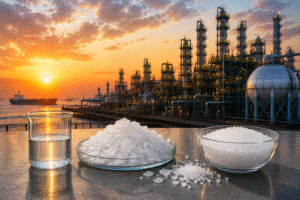
Caustic soda’s price trend just got a lot more interesting. China’s FOB rate for May 2026 sits at USD 91.38/MT. India’s CIF rate? USD 159.38/MT. That’s not a small gap it’s a USD 68 difference, and it’s roughly 74% higher landed in India than what China’s exporting at.
Numbers like that don’t happen by accident. Caustic soda feeds into alumina refining, textiles, soap and detergent manufacturing, pulp and paper pretty much any industry running a chemical process needs it somewhere in the mix. When the price moves this much between two major Asian markets, buyers notice.
Current Caustic Soda Prices: China vs India
| Product | Region | Incoterm Basis | Price | Last Updated |
|---|---|---|---|---|
| Caustic Soda | China | FOB | USD 91.38/MT | May 2026 |
| Caustic Soda | India | CIF | USD 159.38/MT | May 2026 |
Almost double. Not quite, but close enough that anyone comparing the two numbers side by side has to stop and ask why.
Part of the answer is the incoterm itself. FOB just covers the cost of getting goods loaded onto the vessel at the origin port — freight, insurance, everything after that is on the buyer. CIF is the opposite: the seller’s price already includes freight and insurance all the way to the destination port. So India’s figure is carrying a lot more baked into it from the start.
That said, incoterm differences alone don’t explain a gap this wide. Something else is going on.
Why Such a Big Gap Between China and India?
China exports a massive volume of caustic soda — it’s one of the largest producers globally, with chlor-alkali capacity that dwarfs most other countries. That scale keeps FOB export prices competitive, sometimes aggressively so, especially when domestic Chinese demand softens and producers look to move volume overseas.
India’s situation looks different. Domestic capacity exists, sure, but it doesn’t always keep pace with demand from alumina, textile, and paper sectors. Imports fill the gap. And imported caustic soda carries freight costs, port handling, currency conversion, sometimes anti-dumping duties depending on the origin — all of which stack on top of the base price.
So is India just paying a premium for the same product? Largely, yes. The molecule doesn’t change. What changes is everything wrapped around getting it from a Chinese port to an Indian buyer’s warehouse.
Does that mean Indian producers benefit? In a sense. Higher import costs make domestically produced caustic soda more price-competitive, which is part of why several Indian chlor-alkali players have been expanding capacity over the past couple of years.
Could the gap shrink? Possibly, if Chinese export prices firm up or Indian import duties change. Neither looks imminent based on current data, but chemical markets shift fast.
What’s Driving Caustic Soda Prices Right Now
A few forces sit behind these numbers.
Energy costs matter more for caustic soda than most chemicals — chlor-alkali production is electricity-intensive. Power prices in China directly affect how cheaply producers can manufacture and still export competitively.
Downstream demand plays a role too. Alumina production alone consumes enormous volumes of caustic soda globally. When aluminum demand shifts, caustic soda demand follows within a quarter or two.
Then there’s co-product economics. Caustic soda gets produced alongside chlorine in the same chlor-alkali process. Producers can’t make more of one without more of the other, so chlorine demand — used in PVC production, water treatment, and more — indirectly shapes how much caustic soda hits the market.
Freight rates hit India’s number harder than China’s, since India’s price already has that cost baked in. A spike in shipping costs out of Chinese ports widens the gap without either country’s underlying production economics changing at all.
What This Means for Buyers and Investors
Procurement teams sourcing caustic soda for Indian operations are staring at a real cost decision. Domestic supply, even at a premium over raw China FOB pricing, might actually come out ahead once freight, duties, and lead times get factored into total landed cost.
For companies with import flexibility, China’s FOB pricing looks attractive on paper. Getting it landed competitively, though, requires locking in freight rates and factoring in any applicable duties — the FOB number by itself isn’t the whole story.
Investors watching the chlor-alkali space in India have a fairly clear signal here. A near-74% price gap between domestic-adjacent supply and imports doesn’t close on its own. Capacity expansion, import substitution — these aren’t just industry buzzwords, they’re a rational response to the math.
Q2 2026 Outlook
Where this goes depends on two things mostly: Chinese export pricing and Indian import policy. Neither is fixed in stone.
If China’s domestic demand stays soft, expect continued export pressure — meaning FOB prices could hold steady or even dip further. India’s landed cost, though, is less about China’s base price and more about freight and duty structures, which move independently.
Buyers locking in Q2 contracts should treat May 2026 numbers as a reference point, not a promise. Chemical commodity pricing this volatile doesn’t sit still for long, and a month-old snapshot can already be stale by the time a contract gets signed.
Conclusion
The caustic soda price trend for Q2 2026 shows a wide split — USD 91.38/MT FOB out of China against USD 159.38/MT CIF into India, both as of May 2026. That’s not a rounding error. It reflects export scale in China, import dependency in India, and everything freight and duties add on top. Anyone sourcing, investing, or advising in this space needs to be tracking these numbers closely, not glancing at them once a quarter.
FAQ Section
What is the current caustic soda price trend in China and India?
China’s FOB rate for May 2026 is USD 91.38/MT. India’s CIF rate is USD 159.38/MT — nearly 74% higher. The gap comes from incoterm structure, freight and insurance costs, and India’s reliance on imports to meet domestic demand.
Why is caustic soda so much more expensive in India than China?
China exports at scale, keeping FOB prices competitive. India imports a meaningful share of its supply, and CIF pricing adds freight, insurance, and sometimes duties on top. Domestic Indian capacity hasn’t fully closed the demand gap yet, which keeps import reliance — and cost — high.
What factors affect caustic soda prices the most?
Electricity costs matter a lot since chlor-alkali production is power-intensive. Chlorine co-product demand, downstream alumina consumption, and freight rates all play a role too. Because caustic soda and chlorine come from the same process, producers can’t easily adjust output for one without affecting the other.
How often does caustic soda pricing change?
It can shift weekly depending on energy costs, freight rates, and regional demand swings. The May 2026 figures serve as a useful benchmark, but buyers finalizing contracts should always pull current pricing rather than relying on a month-old number.
What’s the outlook for caustic soda prices in Q2 2026?
The China-India gap will likely persist through Q2 2026 unless Indian import policy or freight costs shift meaningfully. Chinese export pricing depends heavily on domestic demand strength — soft demand there usually means continued competitive export rates.