Subtotal $0.00

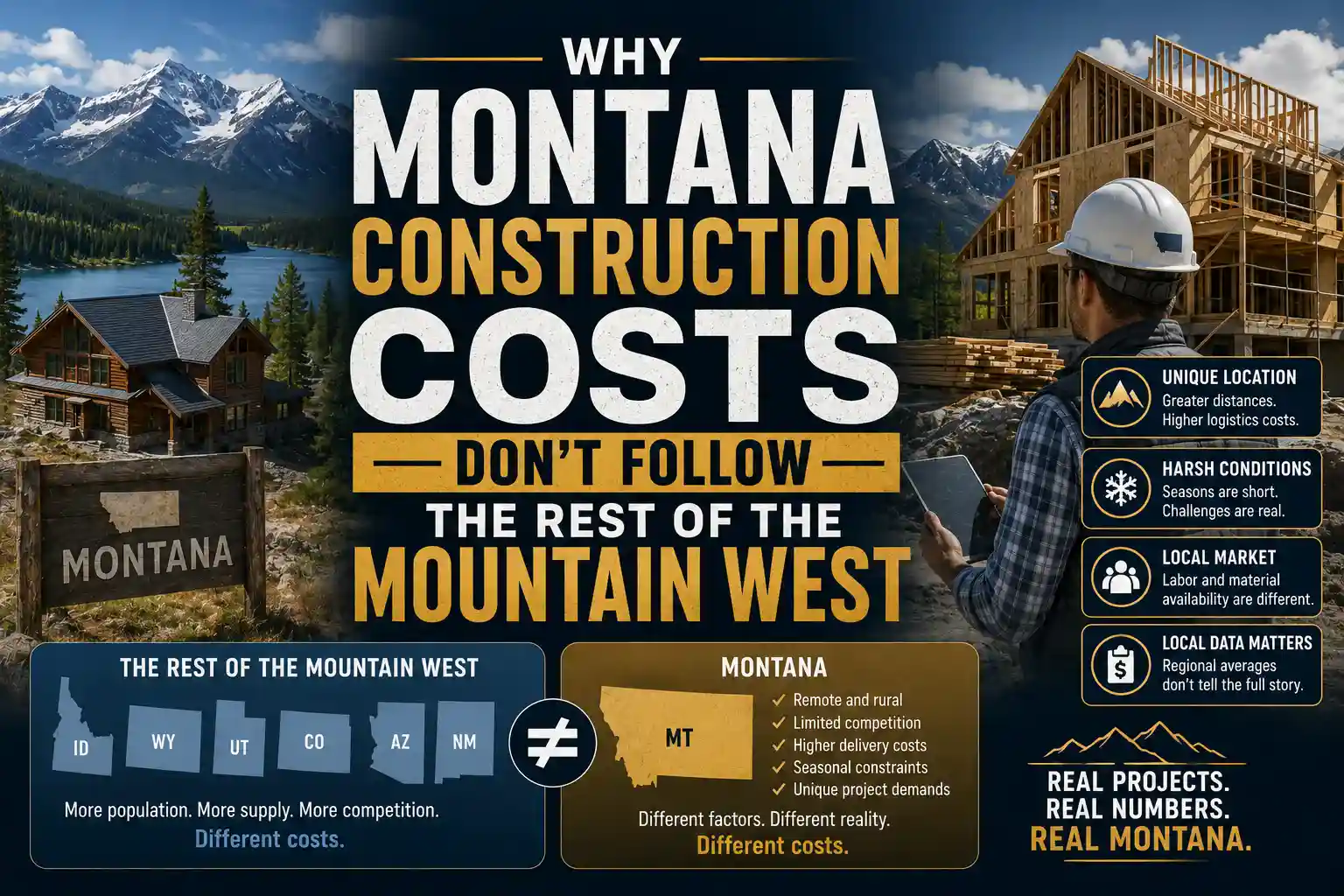
Montana gets lumped in with the broader Mountain West in a lot of regional cost benchmarks, and that grouping does the state a disservice. Montana’s combination of extreme winter conditions, genuinely remote geography outside its handful of population centers, and a construction labor market spread thin across an enormous land area produces cost pressures that don’t track neatly with Colorado, Wyoming, or Idaho, even though they all get filed under the same regional heading in a lot of generic estimating databases.
Frost Depth Changes What “Foundation Work” Means
Much of Montana deals with frost depths considerably greater than what standard national foundation specifications assume, particularly in the eastern and central parts of the state where winter temperatures can be severe and sustained. Footings have to be set below that frost line to avoid frost heave damage, which means excavation and foundation costs in Montana routinely run higher than a generic national or even regional benchmark would suggest, simply because the ground itself demands deeper, more substantial foundation work than milder climates require.
This is exactly the kind of detail that’s easy to underprice using a generic template, because frost depth requirements aren’t uniform even within Montana they vary meaningfully by specific region and elevation, and a bid built without checking the actual frost line for that project’s location is starting from an assumption that may not hold.
The Construction Season Is Short, and the State Is Big
Montana’s usable construction season is considerably shorter than most of the country’s, especially at higher elevations and in the northern parts of the state, and winter conditions can shut down or seriously slow exterior work for a meaningful stretch of the year. That compresses the window in which framing, envelope work, and site work all need to happen, which puts real pressure on scheduling and increases the cost of any delay, since a schedule slip risks pushing work into the following season entirely rather than just adding a few weeks.
Montana’s size compounds this. The state covers an enormous area with a relatively small population, and a project in a remote area away from Billings, Missoula, or Bozeman can face real logistics costs simply getting material and equipment to the site, along with limited local contractor availability. A generic Mountain West benchmark built around Denver or Salt Lake City metro conditions doesn’t capture what it costs to build in Miles City, Havre, or Wolf Point, where the closest supplier or specialized subcontractor might be hours away.
Wildfire Risk Is a Real and Growing Cost Factor
Montana has seen increasingly severe wildfire seasons in recent years, and that’s affecting construction costs in ways that weren’t standard considerations a decade ago. Builder’s risk insurance in higher-risk wildfire zones has become more expensive, and some jurisdictions and insurance requirements now push toward fire-resistant materials and defensible-space site planning for structures near forested or wildland-urban interface areas. A generic estimate that doesn’t specifically account for wildfire exposure in the project’s particular location will tend to understate both the insurance cost and the material specification requirements for exposed sites.
Labor Availability Varies Enormously Across the State
Montana’s skilled trade labor is concentrated in its handful of larger cities, and a project in a rural or remote part of the state often has to pay for travel, lodging, and per diem to bring in crews from those population centers costs that a statewide average labor rate, let alone a national one, simply won’t reflect. This is one of the more commonly underestimated line items in Montana projects specifically because it’s easy to assume labor costs are uniform within a state, when in practice the difference between building near Billings and building in a genuinely remote county can be substantial.
What a Realistic Montana Estimate Actually Needs
Putting this together, an accurate cost estimate for a Montana project needs to account for:
- Region-specific frost depth requirements, since foundation costs vary meaningfully by location and elevation within the state
- A compressed construction season, with real schedule contingency built in for weather-related delays rather than a flat percentage
- Remote-site logistics and material transport costs, particularly for projects outside the state’s larger population centers
- Wildfire-related insurance and material specification costs, for projects in exposed regions
- Labor costs that reflect actual local availability, including travel and lodging for crews brought in from distant population centers
None of these are exotic considerations for anyone who’s actually built across multiple regions of the state; they’re the kind of adjustment an estimator with real Montana project history makes automatically, and exactly the kind of detail a generic Mountain West cost database tends to miss. There’s a solid overview of the trades, deliverables, and areas covered by this kind of region-specific estimating process spanning cities from Billings and Missoula to smaller communities like Baker and Browning on this page on Montana construction estimating services, worth checking against for anyone bidding into the state or reviewing an in-house estimate for regional gaps.
The Takeaway
Montana isn’t just a smaller, colder version of its Mountain West neighbors; its frost depth, construction season length, remote logistics, wildfire exposure, and localized labor markets each shape real project costs in ways a generic regional benchmark won’t capture. A bid built without accounting for these Montana-specific factors is really just a Mountain West estimate wearing the wrong label, and the gap tends to show up exactly where it’s most expensive to discover it: after the project is already underway.